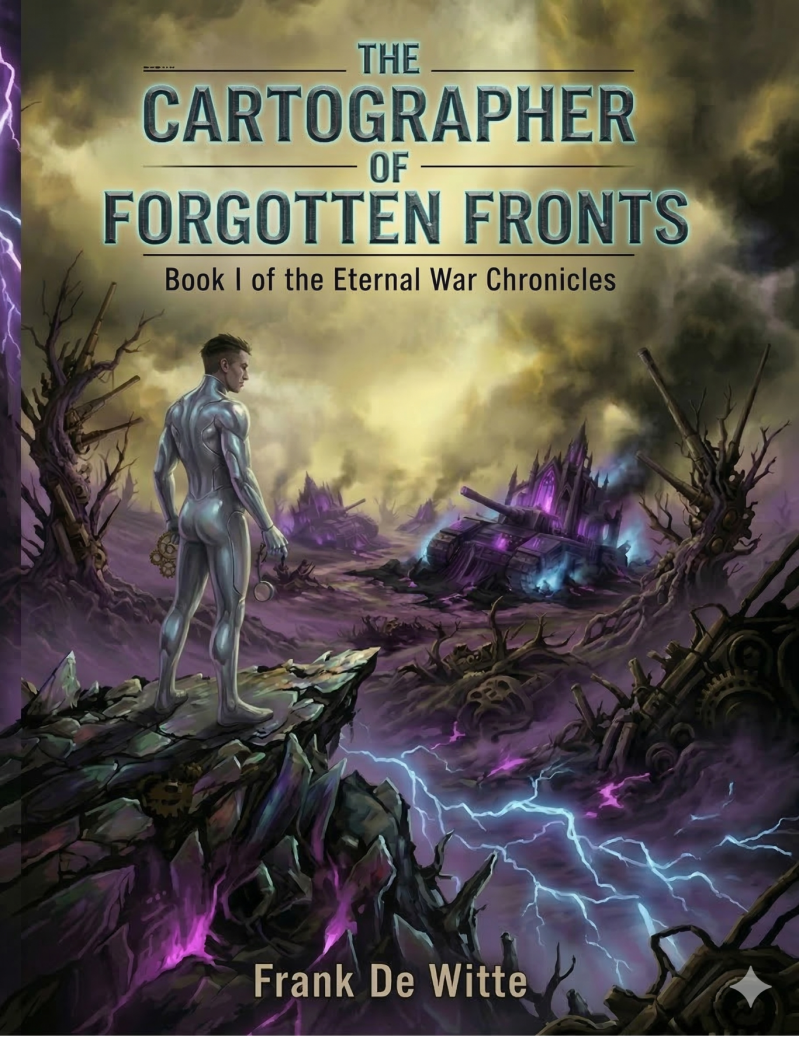
The Geometry of the Wild
Category: Author’s Note
From the Desk of: Frank De Witte
I have always been fascinated by the tension between the rigid lines of human technology and the chaotic, persistent crawl of the natural world. In many dystopian stories, nature is a victim—a scorched earth left behind by the hubris of man. But in the world I’ve built for Elian Vost, nature is something far more interesting: it is an opportunist.
My interest in philosophy and industrial decay often converges on a single question: What happens to the world when we stop looking at it?
In the Eternal War Chronicles, The Hind Presidium spends centuries trying to impose order. They build Citadel walls under a Smog Shield that turns the sun into a sickly yellow bruise. They force their citizens to live by the Doctrine of Continuity, a mandate that ignores the rotting of their "Class-D" recycled gear in favor of 700-year-old data. They treat their maps as a shield against time, even as their "Sky-Silver" rivals from the West watch from a distance, treating the war like a disease that needs a cure.
But nature doesn't care about "Continuity," and it certainly isn't waiting for a cure.
One of the most persistent human delusions is the belief that we can—or should—control the wild. Even when we speak of "preservation," we are usually talking about curation. We want nature on our terms. We want the park, but not the predator; the forest, but not the rot. We take it upon ourselves to decide which species are "good" and which are "invasive," meddling with the scales until the environment fits our specific moral and aesthetic needs.
In the Ministry's archives, this impulse is taken to its logical, dark extreme. The Hind Presidium doesn't just want to save nature; they want to legislate it. Across the border, their rivals in the Horn Dominion attempt a different kind of control, treating technology as "The Bounty" and using sacred grease and prayer to keep the "Deep Ones'" ancient factory running. Both sides try to master a world that is already moving past them.
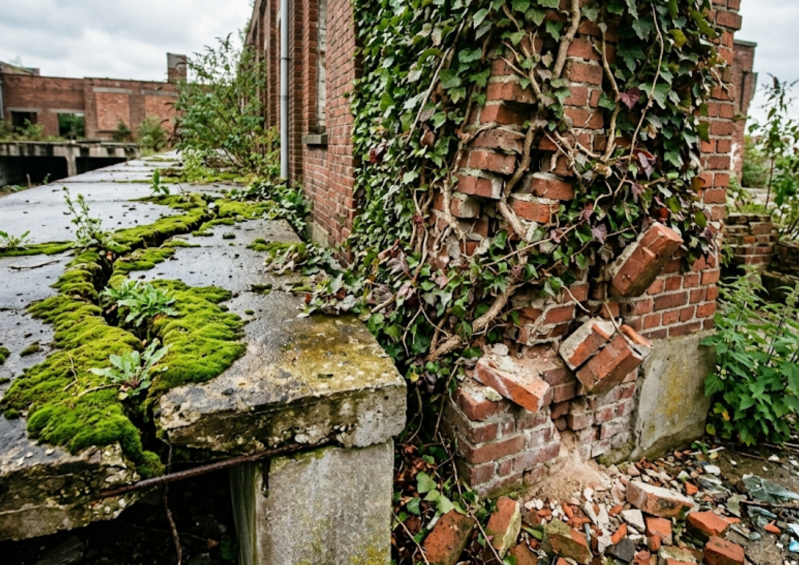
One of the core themes I wanted to explore is how nature evolves and adjusts to the mess we leave behind. I’ve spent years documenting this process through my lens, taking macro photographs of the minute, granular ways nature adjusts itself through the seasons. I’ve watched how moss finds the hairline fractures in concrete and how ivy eventually pulls down a brick wall. It’s an aggressive, slow-motion siege captured in the shift from the frost-cracked iron of winter to the suffocating overgrowth of summer.
Nowhere is this more apparent than at the Horn.
On the Presidium’s maps, the Horn Citadel is a strategic pillar of cold iron. But in reality, it is a calcified spire where nature has stopped asking for permission. The iron is being encased in a new kind of life—a hard, adaptive lichen that breathes high-altitude exhaust and thorns that pierce reinforced plating.
In places like the Horn or the "Orchards" of Sector 4, nature has adjusted to the "Eternal War." These aren't the lush groves of the Ministry’s propaganda; they are biological structures feeding on the heat of lower furnaces and chemical run off. Nature has learned that to survive the war’s "dissonant scream," it must become a weapon itself. It has to evolve as fast as the industry that tries to pave over it.
To me, the most terrifying and beautiful part of a dystopian world isn't the ruined machines—it’s the realisation that the world is moving on without us. It is the philosophy of "The Living Decay." We think we are scarring the earth with our wars and our industry, but we are really just providing a new kind of soil for a nature that has learned to thrive in the dark.
Nature doesn't just reclaim; it rewrites. And as Elian Vost discovers, the new geography is far more dangerous than the old one.
Explore the changing map of the Eternal War.
Learn more about the factions and pre-order your copy of The Cartographer of Forgotten Fronts at www.frankdewitte.com.