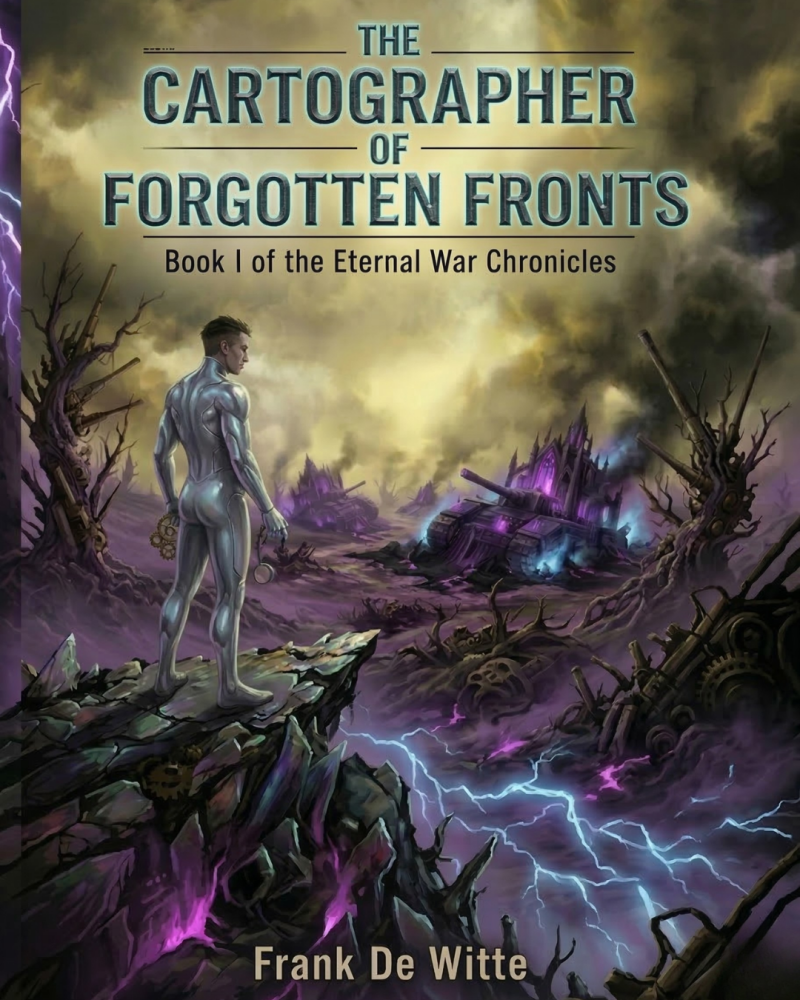
The Logistics of Stalemate
Historical Echoes & Personal Realities Behind the Hind Dominion
[TACTICAL BRIEFING: THE INFRASTRUCTURE OF PERPETUAL WAR]
Category: Behind the Ink / Worldbuilding Design
Focus: The Infrastructure of Perpetual War — a deep dive into the logistical, bureaucratic, and atmospheric mechanics that make a 700-year stalemate feel believable
When readers dive into The Cartographer of Forgotten Fronts, one of the most common questions I get is: How can a war realistically last for 700 years without either side completely collapsing?
The answer doesn't lie in grand strategies or sci-fi super-weapons. It lies in the unglamorous, exhausting world of supply lines, recycling, and administrative inertia. To build the terrifyingly rigid society of the Hind Dominion, I looked closely at the grim realities of our own history; specifically the logistical nightmares of World War I, the industrial stagnation of the late Soviet Eastern Bloc, and fragments of my own lived experiences in places defined by conflict and industrial grit.
Here are the layers that shaped the infrastructure of the Citadel and the Grey Zone:
1. The Shell Shortages and "Class-D" Recycling
In our history, by late 1914, every major European power ran out of artillery ammunition. They hadn't planned for a war of attrition, forcing factories to rapidly transition to melting down civilian scrap metal, church bells, and old railway tracks to keep up with the front lines. Quality plummeted. Shells routinely failed to detonate, or worse, exploded inside the gun barrels.
In the Hind Dominion, this temporary historical crisis has been normalised for seven centuries.
-
There are no fresh iron mines left in the Citadel’s territory.
-
Every piece of Class-C and Class-D ordnance fired at the Horn lines has been retrieved from old battlefields, melted down, re-cast, and refilled dozens of times.
-
When Logistics Officer Jarek stares at his manifests, he isn't managing a military surplus; he is managing a closed-loop recycling ecosystem of rusted iron.
2. The Bureaucratic Freeze (The Soviet Stagnation)
To make the Doctrine of Continuity feel authentic, I drew heavily from the late-stage bureaucracy of mid-20th-century industrial regimes. In those systems, meeting the "Quota" on paper became more vital than reality itself. If a department head reported that a factory had produced 10,000 functional tractors, no one dared point out that half of them lacked engines.
The Hind Ministry of Continuity operates on this exact brand of systemic denial.
-
If a 700-year-old document says a supply depot exists in Sector 4, Elian Vost must draw it on the official maps—even if he knows it was ground into purple sludge by artillery three generations ago.
-
The human capital is managed with the same cold, geometric calculus. If a steam-press technician passes away, their immediate descendants are legally drafted to occupy the exact same coordinate on the factory floor.
3. The Spiritual Fatigue and Unpredictable Shadows (The Echoes of Iraq)
The psychological weight of the universe goes beyond standard trench warfare; it draws from the modern reality of operating in a highly volatile, asymmetric conflict environment.
When writing the tension of the Grey Zone, I drew directly from memories of Iraq—that specific, exhausting psychological strain where the frontline isn't a neat, visible grid line on a map. It’s an environment where threats are unseen, where the rules of engagement shift beneath your feet, and where a sudden, violent disruption can shatter weeks of quiet routine in a split second.
Characters like Jarek and Elian carry that exact survival fatigue. They aren't fighting for a glorious, predictable victory; they are navigating a high-stakes ecosystem of raw survival where a single wrong turn in an unmapped sector means vanishing into the dark.
4. The Physicality of the Rot (The Atmosphere of Greenock, Scotland)
Finally, a world needs to feel heavy, wet, and relentlessly atmospheric if the reader is going to believe in its decay. To capture the endless, oppressive dampness of the Vrail Basin, I channeled the distinct visual memory of Greenock, Scotland—a place rooted in heavy shipbuilding heritage, framed by gray waters, low skies, and a persistent, bone-chilling dampness that feels as though it has seeped into the stone buildings themselves.
In the Grey Zone, the air isn't just cold; it’s an active weight. The fog doesn't just block your vision; it clings to the rusted joints of steam-armor and leaves a metallic taste on the tongue.
When the Reconnaissance Initiative arrives with their pristine Sky-Silver ships and optimized electronic data streams, they think they can easily untangle this mess. They fail to realize that the central continent isn't a math problem to solve—it is a seven-hundred-year-old machine running on recycled iron, deep-seated trauma, and mud that never dries.
Plunge into the deep archives of the Grey Zone today. Order The Cartographer of Forgotten Fronts at www.frankdewitte.com.
#Worldbuilding #AlternativeHistory #MilitaryHistory #GrimdarkSciFi #TheCartographerOfForgottenFronts #FrankDeWitte #AuthorLife #WritingCommunity