The Visual Language of Stagnation, Devotion, and Optimization
Category: Behind the Ink / Worldbuilding Design
Character Focus: General Korm vs. High Pontiff Varus vs. Sub-Director Aphra
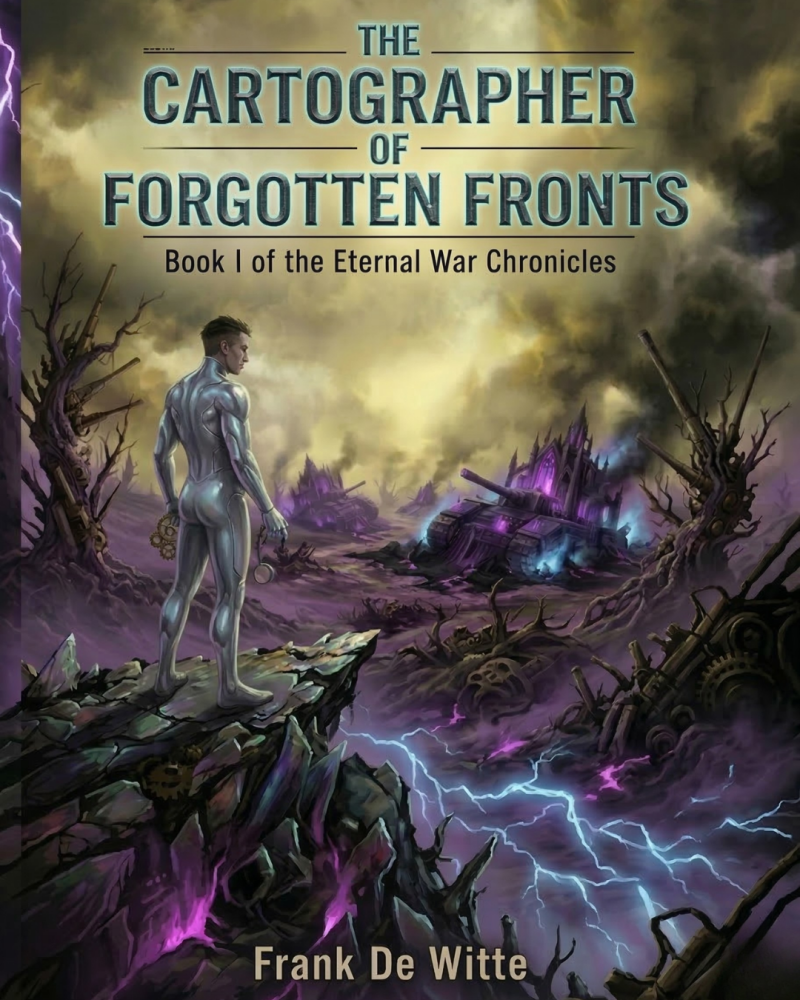
When I sat down to design the world of The Cartographer of Forgotten Fronts, I knew the conflict couldn't just be about opposing armies. It had to be a clash of entirely different visual and cultural philosophies. I wanted the reader to see the ideological divide before a single weapon was fired.
By pulling back the heavy smog, we find that the battlefield is a three-way collision between the heavy, dying industrialism of the Hind Dominion, the hyper-advanced data of the Reconnaissance Initiative, and the dark, ritualistic scavenging of the Horn Dominion.
Here is how I translated those three distinct mindsets into the technology, textures, and visual design of the book:
1. The Hind Dominion: Heavy Iron and Sovereign Lies
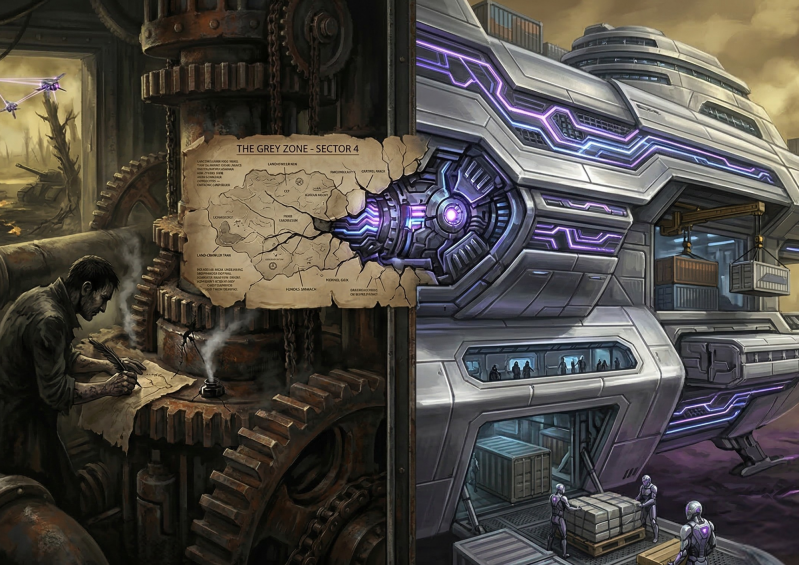
The Hinds live inside the Citadel, a massive fortress permanently cloaked by a Smog Shield that turns the sun into a "bruise of sickly yellow light". Because of this, their entire aesthetic is built around soot, grease, and overwhelming, oppressive weight.
-
The Material: Everything is heavy, steam-assisted iron. Their armor isn't sleek or aerodynamic; it is brutalist, clanking, and built for a permanent war of attrition.
-
The State of Technology: Their equipment is strictly "Class-C" or "Class-D". This means every rifle, tank, and pressure gauge has been recycled, refilled, and repaired dozens of times across seven hundred years. It is technology that feels ancient, soot-stained, and prone to constant mechanical failure.
-
The Leadership Visual: This is perfectly embodied by General Korm. He is a massive man with half of his face replaced by a crude iron prosthetic and a glowing red, sometimes blue, mechanical eye. He represents the brutal reality that iron and industry are the only truths left to cling to.
2. The Horn Dominion: Sacred Grease and Scrap Miracles
The Horns are the Hinds' eternal rivals, but visually and culturally, they operate on absolute faith and rigid religious fundamentalism. They don't view technology through the lens of engineering; they view it as divine intervention.
-
The Material: Their look is a stark, jarring contradiction. They wear rugged, heavily weathered trench coats and gas masks caked in trench grime, but they wield pristine, highly advanced pulse rifles.
-
The State of Technology: The Horns don't manufacture their best gear; they dig it out of the earth. Because they believe these weapons are holy gifts from the "Deep Ones" , their maintenance involves ritualistic prayer and the application of "sacred grease" to keep the mechanisms firing.
-
The Leadership Visual: This religious fervor is masterfully manipulated by High Pontiff Varus, the "Voice of the Deep". He drapes himself in the visual trappings of vanity and power, maintaining control over the starving masses by interpreting the mechanical rumbles of the mountain as the literal voice of the gods.
3. The Reconnaissance Initiative: Sky-Silver and Clinical Hubris
Emerging from the West, the Recon Initiative represents a sterile, high-tech human society that managed to escape the grinding, centuries-long attrition of the central continent. Their aesthetic is a clean polar opposite to the soot-stained trenches.
-
The Material: They utilize "Sky-Silver"—a pristine, polished metal that hovers using magnetic repulsion rather than relying on combustion, steam, or heavy gears.
-
The State of Technology: Their gear is sterile, automated, and hyper-advanced. They don't look at the landscape with human eyes; they view the world through a lens of real-time data streams, environmental sensors, and digital maps.
-
The Leadership Visual: Sub-Director Aphra represents this clinical mindset perfectly. She is tall, pale, and "terrifyingly calm," completely encased in a shimmering, color-changing skinsuit that recycles biological waste to remain perfectly efficient.
The Collision in the Mud: Superior Tech vs. Blind Reality
The true heart of The Cartographer of Forgotten Fronts isn't the weapons themselves, but what happens when these three incompatible worldviews violently smash together in the Grey Zone.
The battlefield is fundamentally one between the Hind and the Horn—a brutal, 700-year cycle of grinding attrition that both empires have normalized. When the Reconnaissance Initiative arrives from the West, they do so with an air of clinical arrogance. They view themselves as "doctors" coming to cure a patient, genuinely believing their superior technology allows them to step in, map the chaos, and clinically enforce a ceasefire.
But they are completely blind to the reality of the central continent.
When Sub-Director Aphra’s sleek, silent silver ship descend into the thick, toxic purple mud of Sector 4, her hyper-advanced sensors begin to short out from the sheer volume of ambient static. Her data streams cannot compute a landscape that actively fights back. The Horns are desperately clutching their pulse rifles, praying to a rumbling earth, while General Korm's forces dig deep with heavy iron machinery to find an "off switch" for the world.
In this moment, the West's technological superiority becomes a liability. Because they relied entirely on real-time sensors instead of historical context, they go completely blind to the rot of the terrain.
In the middle of it all stands Elian Vost—a weary cartographer with a permanent squint and ink-stained fingers. He possesses no advanced weaponry and no shimmering skinsuit. But he possesses memory and an intimate knowledge of the archives. He is the only one who can navigate the chaos, proving that when pristine data and religious fervor fail, raw historical knowledge is the only thing that can map a path to survival.
Order The Cartographer of Forgotten Fronts at www.frankdewitte.com.